

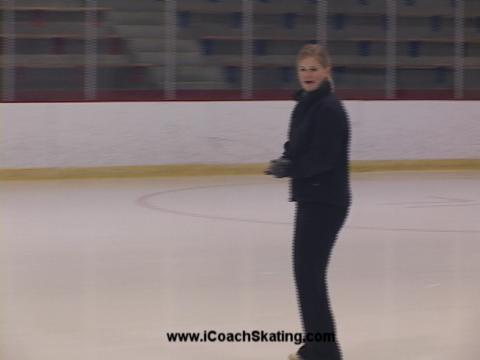
Amy Brolsma explains how she teaches power pulls. Notice that Amy is focused on the mechanics of how a skater generates power from a continuous edge. And just like other top coaches, Amy simplifies the movements to their most basic mechanics. This keeps the rest of the skater’s body “quiet” so the skater can truly focus on just the movements that produce the power.
For example, Amy keeps the free foot quiet and beside the skating foot. She also keeps the shoulders still and has the skater use a hula hoop to be more aware of body motion. This simplifies the movements to just knee action and edge pressure.
Forward power pulls are done near the back of the blade while backward power pulls are done near the front of the blade.
Note: Please compare Amy’s treatment of power pulls with that of Karen Heng Olson here. Karen also emphasizes that skaters do NOT get power from swinging the free leg. But Karen encourages shoulder movement while Amy does not. Even these successful coaches disagree about how best to introduce power pulls.
These alternatives have caused some confusion. Ultimately, power pulls are performed more efficiently and comfortably with strong shoulder movement. So having shoulder movement is desirable and all skilled skaters with strong power pulls will naturally have this. Karen introduces this movement immediately.
On the other hand, Amy focuses on simplifying the movements so that the fundamental mechanics of power generation from the lower body can be easily mastered without “distraction” from the upper body. In essence, Amy wants her skaters to master the most basic aspect of power generation before adding additional body movements. Eventually, Amy’s skaters will naturally develop the appropriate shoulder movement as a natural consequence of proper power generation.
Both methods work. Some skaters will have faster progress with one approach or the other and most coaches also have a preference based on what has worked best for them and their skaters.
Final note: Skilled skaters should be able to generate power from an edge regardless of shoulder position or movement. This is a skill that’s necessary to allow complete freedom for artistic expression and execution of choreography.
Please leave a comment and let us know how you teach power pulls or how you learned them.

 Add to “My Favorites” (Beta testing)
3 responses to “Power Pulls Ice Skating (Amy Brolsma)”
I teach power pulls on two feet first, beginning with a basic alternating half swizzle pump, to slalom. I introduce the shoulder motion once the basic slalom is mastered, and then I progress to an “S curve” where the feet are both on the ice with one in front of the other. This way, my skaters are comfortable and in control of the pressure and motion of both the shoulders and free leg before I ask them to do a full power pull. I prefer this so far in my teaching because I do not like to change what I ask the skater to do; I prefer a smooth progression of difficulty so they understand what my ideal technique is from their first days practicing it. This is particularly important for me because a very recreational club I work at has skaters with very little lesson time who often work together, so I want them all to be on the same page with what they should be doing.
Hi Amy, that’s great, but I was wondering you teach this with a skater who does not know power pulls, and walk her through it. If this was made in parts would be even better same as you did a very good job on teaching choctaws.
I do not understand how the free foot moves, it was too fast for me.