
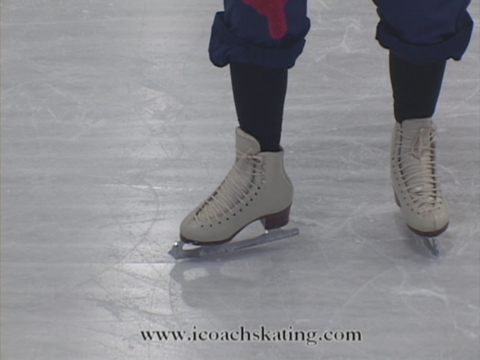
Joan Orvis offers important insights about edges in figure skating. With the move away from school figures in the 1990’s, more than a generation of skaters has now grown up without them. They have also grown up without some of the important terminology and concepts that school figures provided.
One of these important concepts is “putting pressure on the edge” or using the ankles to create “edge pressure.” In this video, Joan goes into detail about what this actually means and how a skater creates proper edges and turns using the ankles.
As Joan says, “In teaching I think we teach bending the knees too much without any emphasis on the ankles.” Joan explains exactly what she means. Ankle pressure is not just bending the ankles as the knee comes over the toes, but also dropping the ankle inside or outside to get to the desired edge. Skaters have to learn “how to get your boots to move side to side.”
Joan demonstrates what she wants the skater to do by rolling up her pant legs so they can see the actual ankle position and movement. Here’s a classic quote from Joan that all skaters and coaches should thoroughly understand: “What controls the blade is your ankle, your knee, your hip, your shoulders, and your head. And I think that kids get all the way from the head to the knee and then they stop. And from the knee down is that finesse of being a good skater.”
Right from the beginning, Joan has her skaters use their ankles properly on rocking horses. But she reluctantly notes that it is very difficult for skaters to develop proper ankle development (ligament, tendon, control, etc) without the controlled environment of school figures.
Joan goes on to discuss how the jumps are affected by poor ankle control and poor edges. She believes that some of the injuries we are seeing are a result of poorly trained edges. But she also notes that the kids that she has taught figures to have a much easier time learning the jumps. For example, Joan mentions the loop jump and how she tells her skaters “the edge initiates the rotation.” Without a proper back outside edge, it is essentially impossible to properly control the jump.
As you can see, Joan is passionate about school figures and their importance in skating. A great many coaches agree with her. If you agree, please leave a comment below.
Please leave a comment below for Joan or for other members.

 Add to “My Favorites” (Beta testing)
12 responses to “Figure Skating Edges: Ankle Pressure And Edge Pressure (Joan Orvis)”
Great video! My sister and I both skated many years ago. I did figures but she didn’t. Now that we have returned to skating as adults, we have found that my edge control and ability to check is still able to help me with my jumps while she has struggled to gain the same amount of control. I may have disliked them as a kid, but am SO thankful now that I did them!
Joan, I did figures many years ago and have returned to skating now about five years and have not been able to get those nice edges back I had on the eights. Your video is very helpful and I will go back to my figure eights to work on deeper edges.
Hi Joan: This was awesome! And I also agree that eliminating figures didn’t do skaters or skating any favors. This would be a daunting task, but might you show us how you would teach the figure 8 on all 8 edges? Thank you for sharing your wondering insight.
JOAN!! I sooooooo agree with you about watching freestyle skaters perform and do jump after jump, spin after spin, but with no real depth of edge. It’s very important! And, for me, makes watching skating much more enjoyable….not too mention that it is absolutely better for the skaters to develop those muscles, tendons, and ligaments to help prevent injury.
I agree about the lack of edges in skating. I also did figures & loved the ‘quiet time’ to focus on control. Figures to me relates to letters in the alphabet. You have to know your letters before you can form words then sentences. Thanks
So much wisdon Joan! Thanks for sharing:)
Really great information. Thank you!
Bravo from a fellow dinosaur!! Edges are the basis of skating and we can only hope that exercises based on figures will be introduced to more training programs.
Very helpful. Thank you. I’m sold on the importance of me practicing figures!
Thank you very much for sharing your knowledge and insight. Additional Edge practice begins tomorrow!
I’m coming back to skating after being away from it for 14 years, and OMG my ankles!! I mentioned to my mom that even though I’ve been working on my sr.silver skills this season, I’m still no where near where I feel I should be for ankle strength. She asked if I was doing any figures, and I said “Not as much as I would like to be, it gets in the way of the other skaters.” Her response “Skills won’t give you the ankle training you need, hunny. You have a rink at home – do your figures there.” For the record, my mom was NOT a figure skater, but even she could see the difference in a skater following the expulsion of figures from the sport. As a newly certified coach, figures will be a part of any training program for my skaters. They are just so valuable for so many reasons!
If I had a magic wand, I would embed this video into every skater’s phone so that every time they pick it up, they have to watch it first as a reminder of what skating could be. At the very least, I’d embed some version of it on my own phone. Great post! I’d be curious to learn more and see a breakdown of ankle bend and edge depth in some of the updated jump takeoffs we’ve seen on this site.