

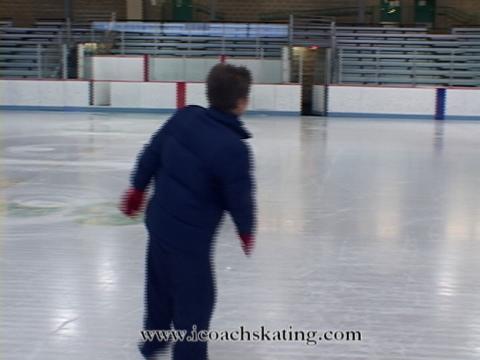
Joan Orvis continues her multi-part description of the waltz jump. Please go back and review Joan’s comments in Part 1 and Part 2. In this video, Joan clarifies some points that she made earlier and adds additional information.
In particular, Joan addresses the free leg and free foot position on the take-off edge. In the previous video she said she wants it in a “collected” position. In this video, she explains what she means by that in a waltz jump or axel. It is the same position as the collected position in figures except the free knee is bent and the free skate is further from the ice. The free toe is still over the trace. Note that the free leg is NOT straight.
Joan also shows how she helps a skater develop the proper feeling for the free leg motion with an exercise at the boards. She says, “Bend, through, up” to emphasis that the free foot actually moves through before the skater jumps out of the skating knee. Notice again the focus on getting to the toe pick, the bent free leg throughout, and the goal of passing the free foot right next to the skating foot.
Joan also addresses the problems with stepping onto a bend knee with the free leg stretched straight back. With that approach the free leg is more likely to swing around in the jump and this makes the jump spinny and low. As Joan says, “There’s no way of converting that position into an efficient vertical jump. You need to have both legs bent and both legs working for you. And the free foot has to pass close.” Joan goes back and demonstrates what she means with a bunny hop.
At 4:52 in the video, Joan addresses the old-fashioned way of teaching a waltz jump. This old-fashioned approach had a straight free leg throughout the jump. This historical approach to the jump should not be taught anymore.
Our focus today is on creating good axels, double axels and triple axels and the old-fashioned approach causes too many problems for these modern jumps. Joan thinks kicking the free leg through with the leg straight takes the jump off course. Additionally, it becomes nearly impossible to quickly collect the extended leg into an efficient rotational position. As Joan says, “You can’t get over it before hitting the ice.”
Unfortunately, the old-fashioned teaching method for this jump is still in use. This is sad as the skaters that are learning it this way must relearn the entire take-off to do a good axel or double axel.
Editors note: Many skaters cannot control their forward outside edges when they are first learning a waltz jump. These skaters will often struggle to control the edge by laying their bodies out into nearly a spiral position to slow the rotation that they cannot control. It is better to work on the forward outside edge with these skaters as Joan explains. The skater should always be under control.
Please leave a comment below for Joan or for other members.

 Add to “My Favorites” (Beta testing)
2 responses to “Waltz Jump Tips – Part 3 (Joan Orvis)”
great detail- thanks Joan!
This is a master class, how many details we sometimes overlook! Thank You