

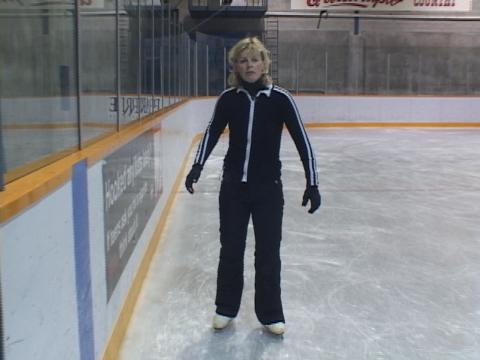
Olympic coach Michelle Leigh provides a thorough explanation of how she teaches the flip jump. There are some extremely important key point in this presentation.
As with her other jump introductions, Michelle teaches the flip near the barrier so the skaters can see themselves in the glass. Head control in jumps is extremely important and Michelle wastes no time in developing proper head positioning and movement in her skaters.
Notice that Michelle assumes the skater can do a proper three-turn prior to working on a flip jump. If a skater is unable to control the three-turn (or mohawk), they are not really ready to start working this jump. An uncontrolled three turn can cause a wide range of other problems with the jump that become very difficult to correct later on. Notice that Michelle not only wants control of the three turn, but a very specific position afterwards. This position can be characterized by a strong reach with the arms fully extended with the back arm lifted and the front arm lowered.
Next, Michelle addresses a key timing point when the pick enters the ice. At the moment the toe pick enters the ice, Michelle wants both of the skater’s hands in front of them with their shoulders and head facing the glass. Focusing on this timing position has several benefits. First it eliminates “blocked” or “stuck” flips that don’t want to rotate. Many skaters will check the three turn so hard that they don’t release the right arm soon enough to allow natural rotation to occur in the jump. Second, the position minimizes pre-rotated shoulder and head positions which often destroy the jump axis and reduce the jump height. This timing tip is one of the most important and practical tips ever published here at iCoachSkating.com and it applies to skaters and coaches troubleshooting double and triple flips as well. This is a timing point that coaches can “train their eyes” to see in real time, but video analysis can really speed this process.
After drilling the timing point, Michelle has the skater continue to pivot naturally on the toe pick and jump. She does not explicitly say it, but notice in her demonstration that she pivots to forward on her take-off. Pivoting completely to forward is not necessary, but it does help most skaters learn the jump faster. (See Nick Perna’s explanation of how to teach a flip jump.)
Editor’s note: There’s another important concept that Michelle does not explain in this video but she does demonstrate it nicely. Notice that in the walk throughs that Michelle has a fully extended free leg prior to the pick placement. But notice that she does not put the pick in a long way back and then draw her feet together. Instead the pick enters the ice relatively close to the other foot and there is essentially no “drawing action.” Michelle’s approach to the jump is extremely common among top coaches that study a lot of video. Unfortunately, this approach has not yet caught on with most coaches as a very high percentage of coaches in the United States still teach the classic “reach and put the pick in as far back as you can and then draw the feet together.” Unfortunately the vast majority of skaters cannot actually do the jump this way (as proven by video analysis) and a very high percentage of skaters cannot feel any “drawback” in a good flip jump. In fact the most athletic skaters feel a jumping motion almost immediately after putting the pick in the ice and this would be impossible if they had to instead draw the feet together. [If it’s almost impossible to do the jump this way and skaters cannot feel it that way anyway, why do so many coachse keep teaching it that way?]
Next Michelle addresses how the toe pick enters the ice. She wants the toe pick mostly straight to avoid dropping to the blade edge on the pivot through. Dropping to the blade edge can be very dangerous for the skater and results in loss of jump height as a minimum consequence. This should be addressed at the very earliest levels with flip. Michelle discusses the common approach to teaching flip by explaining to the skater that it’s just a loop jump. This method works, but it is critical to make sure the skater does the “loop” jump part entirely on the toe pick.
To start developing the double, Michelle has the skater do a single near the glass and add a backspin.
Finally, Michelle talks about how to make sure that skaters learning a flip understand the jump comes off an inside edge. By teaching the jump on a curve as Michelle does, the skater will not be in a position to drop to an outside edge as they might if they were learning the jump in a straight line. After the skater has developed the flip sufficiently, the jump entry can be flattened to a more straight entry without risking the dreaded edge change.

 Add to “My Favorites” (Beta testing)
7 responses to “Ice Skating: Flip Jump Video (Michelle Leigh)”
Thanks for demonstrating this move several times. You take your time to go through the leg and arm movements and this has helped me greatly as a skater. Sometimes the instructors talk too fast or the audio is not very good but your videos are top notch ! Thank you again !!!
Thank you thank you thank you!! Now I understand!! None of my coaches (7) have ever explained this jump like a loop before…it makes perfectly clear sense now 🙂 This was the video I’ve been waiting for…Thank you so much again Michelle and Trevor for this awesome information and for this treasure of a website 🙂
Everythng I want to say has been said. Michelle has provided such great information and it has made such a difference to my jumps! Thank you!!!
This is great! I’m so happy to have watched this! She’s such a wonderful teacher and demonstrator.
Michelle, I love your explanations and demos. So informative and I have learned tons from you!
Trevor, your note explained EXACTLY how I learned the flip. It’s intimidating teaching freestyle when I feel I’ve learned everything “wrong”. I am so appreciative of all the time and effort put in to teaching these new methods. Thank you, Michelle for your excellent presentations. And thank you, Trevor for putting it out there. Keep ’em coming!!
Thanks Michelle. Great video as always. Your videos have helped me so much. Looking forward to your next one!!