

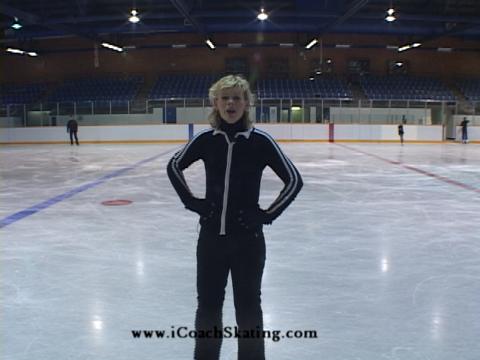
Olympic coach Michelle Leigh explains her approach to teaching the salchow. This video is packed with very important information that is easy to overlook.
Right at the start, Michelle makes it clear that the skater must have 100% control of the preparation edge. Whether the skater uses a forward outside three turn entrance or the back outside three turn/mohawk entrance (or any other entrance), Michelle wants the skater to become still. As she says, the skater needs to be “balanced before they make any move at all.”
Probably the most common error on salchow is that skaters immediately allow the free leg to swing inside the circle on the preparation edge without fully checking the rotation of the entrance turn(s). This is the primary cause of swingy and inconsistent salchows. Notice that Michelle wants the free leg to be completely behind the skating foot. In the old days this was referred to as “over the trace.” Michelle says “the free leg is straight behind the curve.”
After gaining complete control of the preparation edge position, the skater places the free foot side by side with respect to the skating foot. Michelle wants the feet to be separated widely and this is another common error for salchow. Many skaters take the free leg straight forward and brush past the skating leg without the wide positioning. This usually causes a scratchy and choppy jump with little rotational energy.
Notice the strong focus on head position. This is very common among top coaches. Michelle’s exercises in front of the glass are exceptionally effective for “head turners.” She shows exactly how to set the jump up to use the glass properly. Also notice in this presentation that Michelle is helping her skaters create a forward take-off for the salchow. And contrary to some misinformation out there, the salchow like ALL jumps lifts off the toe pick.
Right from the beginning Michelle attempts to develop the proper step up into the jump. This means driving the free knee up while pressing down on the skating toe pick during the jump movement. It also means making sure the free foot continues forward past the skating leg.
Clarification: There has been quite a bit of confusion by many coaches who have seen some of Michelle’s previous videos at iCoachSkating.com. In particular, many coaches have misunderstood Michelle’s presentation on shoulder and head movement and head, shoulder, and hip movements in her jump theory videos. In this salchow video, notice exactly how Michelle demonstrates the jump movements. The shoulders and hips stay locked together as the skater turns forward to take off while the head stays locked in place looking at the glass. (Many skaters allow the shoulders to lead the hips into rotation for flip and lutz and this is a valid way to do those jumps, but few skaters can get away with it on salchow.)
Please take a moment to compare Michelle’s approach to teaching the salchow to that of Chris Conte orPage Lipe. Enjoy and please leave a comment.

 Add to “My Favorites” (Beta testing)
13 responses to “Learn To Ice Skate Video: Salchow Jump (Michelle Leigh)”
I tried this numerous times at the the rink. Looking at yourself in the mirror or window really helps..Thank you Michelle !!!
Very helpful! Thank you for sharing these exercises.
Hey Timcoach, that is certainly one approach and probably the most popular. But as I mentioned, many top coaches really want the skater to become COMPLETELY still on the back edge just like Michelle explains. They do not want their skaters to “wind-up” but rather be in a fully controlled position so they can push on the edge in a controlled manner rather than having uncontrolled coiling and uncoiling going on (with a brief moment of stillness). I don’t think there is one right or wrong way regarding this topic. I just made the observation based on what I see from my travels and discussions with top coaches (and my subsequent experiences with my skaters). Of course, this does not address the concept of rhythm which is so important to many skaters, and for them a “wind up” is often necessary. If I get a chance I’ll shoot some video of a skater doing a double salchow off a completely still back inside edge.
Rebecca and Trevor, I don’t think the goal should be to fully check the 3 turn, but to minimize the rotation of the 3 turn or mohawk, then the check holds the rotation back for a moment just like a wind up toy.
Thank you for the great tips! Very helpful!
Great info and love the exercises by the wall.
I agree that rhythm is important, and a well-executed preparation is attractive too. If nothing else, the audience will have more trouble identifying jumps if we abandon standard preps! On another note, I have to say that these videos always give me a tremendous itch to get out on the ice and see if I’m already doing what’s suggested, or could benefit from adopting the advice. Thanks to all of you for putting it out there.
Hey Rebecca – more and more top coaches are exploring exactly this issue. There’s tons of different ways to get to the back inside edge including just reaching back into the position. Most skaters rely on some form of rhythm and find it hard to simply step on a back inside edge and do the jump. But I can state from personal experience with my skaters that it is possible (and a great exercise)
Great presentation, but here’s a question for you–something that first puzzled me as a kid, and I’ve never found a satisfactory answer to it: if the goal is to fully check the 3-turn, and be completely still on that final LBI entrance edge, why are we such sticklers about how we get there? What does all that preparatory turning achieve? It seems to me that I could just skate backwards any old way and reach back with my free foot/arm and nail that position, yet I know that in practice I’d probably find it difficult to do a sal that way.
Thank you for great tips, It is helping to skaters.
great tips and drills!! Thank you so much for sharing your knowledge Michelle!!
Thanks for all your tips on double jump technique, it is helping my skaters!
fantastic drills! thank you as I will test these out on my skater who is learning the double salchow