
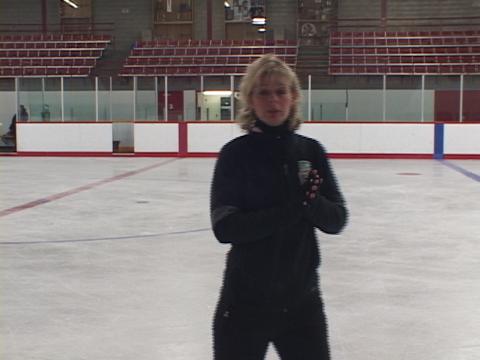
Michelle Leigh talks about how she introduces the waltz jump and she continues the discussion through some helpful exercises that also apply to axel and double axel. There’s value here for coaches at all levels.
In her waltz jump development, notice the simple and fun explanations that Michelle uses with her skaters. “Clapping,” “stabbing with a sword,” and “putting your hands in your pockets” give young skaters clear images to help them remember the proper sequence of movements.
Also notice that Michelle doesn’t focus on straightening the right leg on the step, at take-off, or in the air (for skaters that rotate to the left). She wants the free leg bent throughout the entrance and wants the knee to drive up at take-off, just like in an axel. She explains that she wants young skaters just learning the waltz jump to be learning the proper mechanics for axel, double axel, and triple axel.
Editor’s note: I agree wholeheartedly with Michelle on this. When we get to axel we really don’t want to re-teach the movements. But it’s surprising how often we have to do just that. A good axel has a bent free leg on the step and a bent free leg as the skater lifts off the ice. If you teach young skaters in classes or in private lessons, please stop teaching the straightened free leg, at least on the backswing. It causes many problems that are difficult to correct after muscle memory has set in. The straight free leg method provides “false” forward edge security, tilts the hips out of proper alignment, forces the free leg around rather than through, and usually makes a skater jump around or forward rather than upward. -Trevor
NOTE: Many top coaches teach the waltz jump arm movements the same way Michelle teaches it with forward arm movement (“stabbing”) on the step or push. But many top coaches also teach that the hands push back immediately from the “clap” position during the step. You’ll see both ways when you watch a group of elite skaters.
Finally, Michelle provides some great drills. The drill where she stands at the boards, steps away and jumps at the boards is a truly fabulous drill for many reasons. It gets the skater used to the strong edge needed for axel and it also gets young skaters used to the turn to 90 degrees that the skate makes at the take-off spot. Because the skater is “jumping” into the wall, it gets the skater to press their foot out in front of them slightly to help slow down (so they don’t hit the wall). It also puts the upper body in the correct position so that even though the lower body has started the rotation (with the turn to 90 degrees on the ice) the upper body continues to face the flight direction which creates flow in the jump and helps the skater get to the rotational position faster for the axel.
This is a great video. Please leave comments below.

 Add to “My Favorites” (Beta testing)
7 responses to “Learn To Ice Skate Video: Waltz Jump – Part 1 (Michelle Leigh)”
sweet….i would also like to see michelle discuss position of her right leg where the calf is more horizontal. i would like to understand the differences that would occur with such free leg versus knee stacked over the foot (my coach used the example of stepping up a staircase)
Thank you so much for this demonstration and really outstanding idea of stepping out onto the ice!
Really like the idea of stepping onto the ice from the doorway. I’ll be trying this one out the next time I am on the ice coaching! Thanks.
That was absolutley fantastic! Thank you so much! I learned how to do the waltz jump with the free leg bent on the way back but extended on the way through. It;s difficult to demonstrate with it bent, but I will definitely teach it that way and work on it until I get it myself! Can you teach an old dog new tricks?
I really like the idea of teaching the take off at the boards like that. I’m going to try it with my skaters next time I see them. Thanks Michelle!
Great exercises – I’ve never thought of stepping down from the penalty box – very cool idea. Thanks Michelle!
I liked the details of the Waltz jump, thank you.