
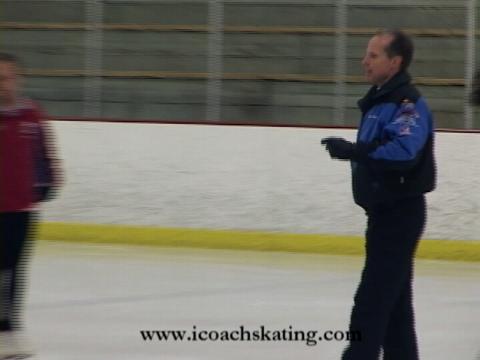
Nick Perna and Audrey Weisiger continue their on-ice axel class at the 2010 G2C Extreme Supercamp. In the first part of the class, Nick Perna covered the proper setup. In the second part, Nick covers the details of the step onto the forward outside take-off edge. Nick makes the point that the skaters should do the setup in the first video correctly so they have the best chance to do the next steps correctly. Nick describes the forward step as:
1. Step forward onto the circle with the skater directly over their skating hip,
2. Left side should be leading and the right side back,
3. Right leg should be back, “kicking yourself in the butt,”
4. Head is up looking where you’re going.
As Nick explains, popping out the skating hip is one of the most common mistakes made on an axel (or double or triple axel). For coaches troubleshooting axels, the hips are one of the issues that can cause skaters to be off axis and routinely fall outside their circle.
Ideally, Nick wants skaters to avoid stepping with their shoulders square or their bodies forward (lunging). Although a number of top skaters do single, double, and triple axels with a square and lunging forward step, video analysis suggests it is not necessary and simply adds more movements and complexity that can cause more problems.
Nick describes it as gliding down a very narrow hallway. The arms should go back very close to the hips. Audrey suggests clapping the hands in front and in back to feel the proper arm movement. Audrey also describes it as putting the hands in a “jeans pocket.” Also notice that Audrey wants the skaters to “cross your wrists” when the arms come forward. This is a classic method of making sure the arms go to a very specific spot, rather than simply flail around.
When they send the skaters to do the drill the first time, they do it with the skaters already skating forward. This minimizes the rotational issues of the step from forward to backward. If a skater cannot hit this position and control the rotation while already skating forward, they have no chance of doing it correctly and under control from the back edge. After the skaters can control this, they add the step from the back edge.
Nick wants the skaters to step onto the circle rather than outside the circle. He also wants to make sure the skaters do not stick out the hips behind them when they put their hands together prior to the step. He also reminds the skaters not to scratch with their toe picks on the back outside edge (and he offers a great tip about not pulling the blade back). Audrey notes that the skaters do not need to push onto the forward edge in this drill.
Editors notes: Three aspects of this presentation deserve some additional comment.
1. Top coaches seem to disagree whether the step into axel is a push or just a step. Video analysis suggests that most top skaters actually push into the jump by pressing their hips forward. The problem with asking lower level skaters to push this way is they tend to push by lunging with their upper body and letting their hips drift back. Thus, it is often easier to teach it as just a step rather than a push if the push is not done correctly. On the other hand, it can be a push if the coach is very demanding about what type of push is used.
2. The demonstration that Nick gives of the forward take-off edge is not strictly what most top skaters do, although it may feel this way to many skaters. In particular, most skaters step forward with the upper part of the free leg pointed straight down at the ice with the lower leg parallel to the ice or raised slightly higher. Instead Nick shows it as a very open hip with the knee turned open and the free foot pulled back fairly strongly. This is a very common walk-through position used by many coaches. But it is not what most skaters actually do and other coaches have proven that it is not necessary to do a walk-through this way. The position that Nick shows can be helpful for skaters to feel that the free side stays back strongly, but it also can cause problems with many skaters that overstretch the free leg and free hip on the forward step. Every coach needs to determine what works best for them and their skaters.
3. Ah, the controversy of stepping on the circle or outside the circle. Nick and Audrey promote stepping on the circle, but video analysis implies that most top skaters step slightly outside the circle. An analysis of the physics of the take-off support stepping slightly outside the circle, as the deepening take-off edge will eventually allow the skater to jump with the flight path over the original circle (or tangent to it) and therefore preserve the kinetic energy and momentum of the entry. However, because so many skaters attempt to create rotation by stepping too far outside the circle (so they can feel a stronger outside edge), it is easier for most coaches to simply ask their skaters to step on the circle as suggested by Nick and Audrey.
Please take a moment to share your thoughts below. Nick and Audrey are active members of the website and will see your comments. Let them know what you thought of the video.

 Add to “My Favorites” (Beta testing)
6 responses to “Figure Skating Jumps: Axel Class – Part 2 (Audrey Weisiger & Nick Perna)”
Thanks Nick and Audrey! Thank you for the detailed description. I have always taught stepping a little outside the circle, but I will try this technique! I appreciate your time, as always!
Thanks Sheila! This site is simply amazing!! Thanks for all the tips!
Monika!! CONGRATULATIONS!!! We’re so proud of you!
Thanks so much for these videos! After applying these techniques, I landed my first axel two days ago! I not only landed it clean the one time, but three times during the session after struggling for eight months learning it! Thank you thank you! 🙂
Thank you so much for posting this important video and taking the time to write the detailed explanation and noting comparisons. Think it all goes back to body alignment that goes for stroking, edges, etc. Shoulders over hips. Forward outside edge – skating hip leads free hip is back. Whether to step outside of circle a little or on the circle? Guess I should try it both ways to see what works better
I find the head is a major problem with skaters. If they control the head the rest of the jump usually follows. I have been doing the set up since Nick’s last video with the hands brushing the hips & have seen higher & more controlled jumps, even from my Basic Skills skaters. Thanks