

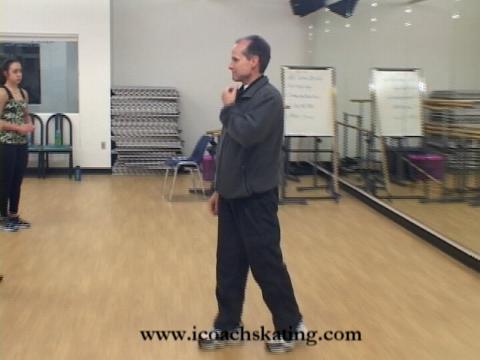
Nick Perna continues his off-ice jump class. This is the fourth part of a multi-part video series (see Part 1, Part 2, and Part 3). In this video, Nick has the class do standstill jumps or standstill air turns. This is probably the most common off-ice jump drill and is used widely, although it is generally not done correctly.
In this advanced class, Nick does not need to spend any time teaching the skaters how to rotate and jump at the same time. But for younger and less experienced skaters, that is often necessary.
Here Nick gives very specific instructions on what he’s looking for. He wants minimal body movement. Notice that he also wants the starting and ending positions to be identical. That means he wants the left arm in front for skaters that spin to the left. This mimics the left side in front on backward take-off jumps. It also mimics the correct arm position at landing (impact) that is so critical to help decelerate the rotational forces on the ice.
The skater should also have enough control to land with square feet. For skaters that lose awareness in the air, this is often a very difficult concept.
Common problems in the class are leaning forward or backward, but the biggest challenge that most skaters face is they tend to land out to the left. That’s why it can be so helpful to do these drills in the mirror. I included video of the class so you can see some typical problems to watch out for and correct immediately.
Links to all videos in this series: Part 1, Part 2, Part 3, Part 4, Part 5, Part 6 , and Part 7.
Please take a moment to share your thoughts below. Let Nick know what you thought of the video.

 Add to “My Favorites” (Beta testing)
3 responses to “Off Ice Figure Skating Jumps – Part 4 (Nick Perna)”
Great explanation of this drill! Thanks
These videos are just fantastic! Thanks so much for posting.
Just excellent! Nick explains these drills in a way that is easy to understand.