
Figure skating strength and conditioning expert Matthew Blair Davis continues his presentation on the fundamentals of creating an off-ice training program for skaters. In Part 1, Matthew shared his background and talked at length about strengthening a skater’s core to improve stability and power. In Part 2, he discussed balance and strength, and the need for both before working on power. In Part 3, he focused on power and stamina, reminding us that most skaters don’t need power training or stamina training compared to improvements in core, stability, and strength. In Part 4, he finished his discussion of stamina training and moved on to recovery and flexibility training. In this video, he offers insights about how to combine all the previously discussed details into a single, customized off-ice training program.
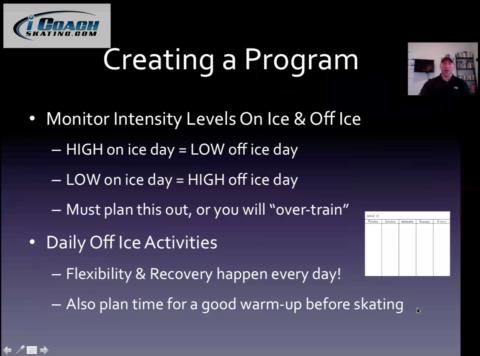
To begin creating a comprehensive training program, Matthew starts by monitoring intensity levels in existing on-ice and off-ice training. During high intensity on-ice days (lots of jumps, programs, etc), off-ice training needs to be lower intensity. Alternatively, on low intensity on-ice days (spins, moves, footwork, etc), off-ice training can be higher intensity. A low intensity off-ice day should consist of a lot of core work and balance work. This should be planned out carefully to avoid over-training and potentially getting injured. Parents, skaters, coaches, and off-ice trainers all need to be on the same page, meaning communication is vital.
Matthew reminds us again in this video that flexibility and recovery training should happen every single day. This means at least 20 minutes on stretching and rolling and getting 8+ hours of good sleep. It’s also important to plan for a pre-ice warm-up before skating each day, typically a 10 minute fixed routine that focuses on full-body joint mobility work.
Next, Matthew discusses the proper progression of focus areas as already discussed in this series (core/balance first, then strength, then power, then stamina). Obviously flexibility and recovery should be part of every phase of an off-ice training progression. Matthew stresses the importance of needing to change specific exercises (stimulus and load) over time to continually force the body to adapt and change to a variety of stresses. He also reiterates here the need to focus on strength training before working on power training. He says, “If you’re not following a progression of first creating stabilization, then strength, then power… it’s just going to produce injury.”
Matthew finishes by sharing his contact information for those who would like to reach out for more information or for a personalized and customized off-ice training program. You can email Matthew at: mbd (at) mbdperformance.com.

 Add to “My Favorites” (Beta testing)