
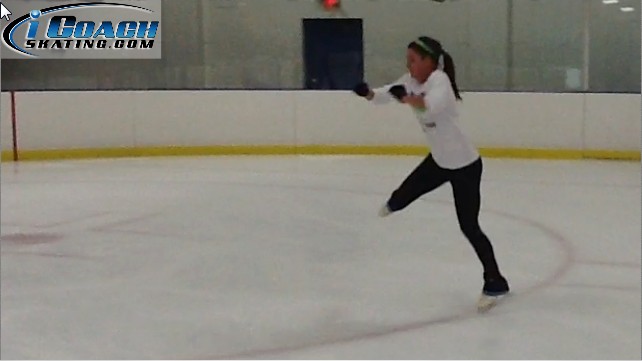
Trevor Laak offers a checklist of insights for axel. This page shows an axel attempt in real time, once as the original video and once zoomed in. The video is then shown again in slow motion for your own analysis and comparison with Trevor’s notes below.
NOTE: This video was captured in response to requests from subscribers for an axel or double axel using the counter-counter axel entrance taught by Michelle Leigh. Here’s the jump (video taken using an iPad2):
Below is a checklist of observations by Trevor regarding this axel.. Analyzing a good double axel provides a way to identify key aspects for single axel instruction.
1. The skater does not “push” into the jump. A push is therefore unnecessary (but can be used and is not prohibited).
2. On the take-off edge, free leg is bent strongly (strongly recommended).
3. On the take-off edge, free foot remains behind the skating foot (“on the trace”) until the free foot gets ready to pass the skating foot as it comes through to do the jump (strongly recommended).
4. On the take-off edge, the free shoulder is held back.
5. On the take-off edge, the body is upright and not leaned forward.
6. The deepening of the take-off edge is caused by edge pressure, resulting from the skater pressing the skating foot forward (required).
7. The arms and hands pass close to the body in a straight line and do not “go around” (strongly recommended).
8. The lower body turns into rotation prior to lift-off and the skater is in a position Trevor refers to as the “sideways karate kick position” at the moment of take-off. The skater’s lower body is sideways and should not be facing the jump direction or facing away from the jump direction (strongly recommended).
9. The hands continue to move in the direction of the jump and the skater continues to look in that direction throughout most of the “explode phase.” The shoulders remain behind the hips rotationally during most of this movement (strongly recommended).
10. The free foot remains on the “target line” after coming through and does not cross or leave the “target line” at any time, especially as the skater “kicks through” and steps up into the jump.
11. The skater uses internal hip rotation to cross the feet and make ankle contact.
12. The skater “winds” (like winding up a toy) into the air position with the shoulders twisting toward the landing side so the landing foot and shoulders line up at landing. The air position is strongly “right-sided” for this skater.
13. On landing, the free knee lifts slightly and the free foot shoots forward prior to being driven backward into the final landing position.
Primarily, Trevor wants the axel’s rotational energy to be created by a strong and controlled entry edge. He wants the edge to deepen without rotational or “around” movement of the arms, shoulders, or free leg.
Please leave a comment.

 Add to “My Favorites” (Beta testing)
3 responses to “Axel Jump Video Tips: Checklist (Trevor Laak)”
Very interesting, I like the checklist and will use this?
I like the checklist
[…] You can see a full video of the jump being analyzed below in real time and slow motion on Trevor’s axel checklist page. (In the video below, Trevor mentions the video clip can be found on this page. But it […]