
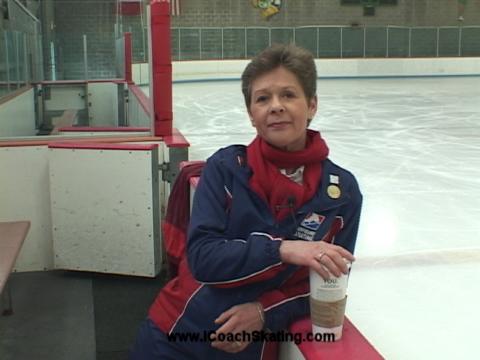
Joan Orvis shares her philosophy of coaching. This is a very personal look into the attitudes and beliefs of a successful coach. Not all successful coaches will have these same beliefs, but it seems that most top coaches have a similar passion and a clear understanding of themselves and their skaters.
As a general rule, Joan gets her students right out of learn-to-skate classes. She speaks of the connection between the skater and coach. This is a common theme among top coaches. She also talks about figuring out how her skaters learn. It is becoming more well-known that all skaters learn differently with respect to sensory input. But Joan takes it a step further and likes to figure out if her skaters are sequential learners or random learners.
One of the biggest takeaways from this video is that Joan, like many top coaches, knows her strengths and weaknesses and knows what kind of skater she works best with. All coaches should self-analyze this for themselves, and all skating parents selecting a coach should also be aware of this important concept. Notice that Joan openly admits she doesn’t do well with certain types of skaters. This takes great self-awareness.
Joan speaks of the excitement and mystery of slowly turning unskilled skaters into well-trained skaters. She speaks of her enthusiasm for connecting and bonding with her skaters and their parents. She talks about her skaters going through life changes while she is also going through life changes. This may sound overly sentimental or even sappy to some, but it helps explain why so many coaches have a passion for what they do. Joan puts it into words in a way that a great many coaches can relate to.
Joan is just as excited for one skater to land her first axel as for another to land his first triple axel. She puts it very eloquently. “That axel that that child landed for the first time is one speck in time. And in a sense, it completes me because I feel I had a part in [creating] that child’s joy.” This speaks of the tremendous satisfaction that so many coaches get from guiding their skaters and growing with them.
Again, Joan perceptively recognizes that some skaters skate because they need someone to talk to every day. They may not be learning much about skating, but coaches often fill the all-important role of mentor and role-model. We’re teaching our skaters life skills, including discipline.
Joan says, “Skating is my number one passion. It’s what I always come back to. When I find a student that shares the same passion, there really isn’t too much that I won’t do to try help that child achieve the maximum. Passion is what drives me.” This is another great perception, and closely mirrors why thousands of coaches head to the rink every day. Coaches are passionate about what they do because their skaters are passionate.
Joan also shares some advice she received from legendary coach Frank Carroll. The advice helped her become a better coach. She says, “It’s on my mind every day. Every day I’m trying to improve my technique.” Again, this attitude mirrors that of top coaches and explains why they continue to push the limits of the sport and continue to turn out great skaters.
Another piece of advice Joan offers to young coaches is to attend conferences. Just being around other coaches with the same passion is a great way to recharge your own passion. And she adds, “I’d say to young coaches, if you think you know it, then you should probably give it up because you don’t know it.” It sounds harsh, but Joan is addressing the fact that as coaches we always have something to learn from others and always have room to improve our own coaching.
She says sometimes after attending workshops, “you come home and you think ooh, maybe I’ve been kind of sloppy and I can do better.” This is another attitude that separates top coaches from average coaches. Top coaches demand precision and discipline in training, while less successful coaches teach with a “that’s good enough” attitude.
At the end of the video, Joan takes a moment to thank her own coaches and mentors, Carol and David Shulman. This tribute is touching and represents the tremendous impact that coaches have on their skaters. This was an emotional discussion for Joan, but most coaches can relate to her experience.
In skating, we rarely get to see or hear this kind of in-depth philosophy from on of our top coaches. And Joan shares it with such eloquence and grace. Thank you Joan!
Please leave a comment below for Joan or for other members.

 Add to “My Favorites” (Beta testing)
8 responses to “Figure Skating Coaches Education: Coaching Philosophy (Joan Orvis)”
very moving, and truly an inspiration…..thank you, thank you, thank you!
I love you.
Thank you for sharing what you think and feel. I find that I attract skaters who share the same passion for the sport as I do – and its always a pleasure teaching them.
“Hats Off” to you, Joan. Great perspective. Thank you.
Thanks very much Joan for taking the time to speak from the heart and being so honest. Really valuable and inspiring stuff! Thanks again.
Can I please come and teach with you. I need the passion back for my sport. Thanks for the video
Thanks for sharing your wisdom with us, Joan. It’s always good to remember why we do what we do!
I’m a skater and not a coach. However, I so appreciate the insights and wisdom shared here. I’m one who learns verbally. I never knew that there were different types of learners: by sight, by ear, by notebook etc… This video makes me excited about learning and working with my coach. Thanks!!!